Adams
Co-drove Steed's TR2 in the 1955 Mille Miglia; it did not finish.
The managers who wanted a Triumph sports car, the engineers and the stylist who made one in a winter, the test driver who proved it, the Belgian who built a coupé on it, and the drivers who raced and rallied it.
About the pictureA sports-car race at Zandvoort in 1955 whose drivers are not named.
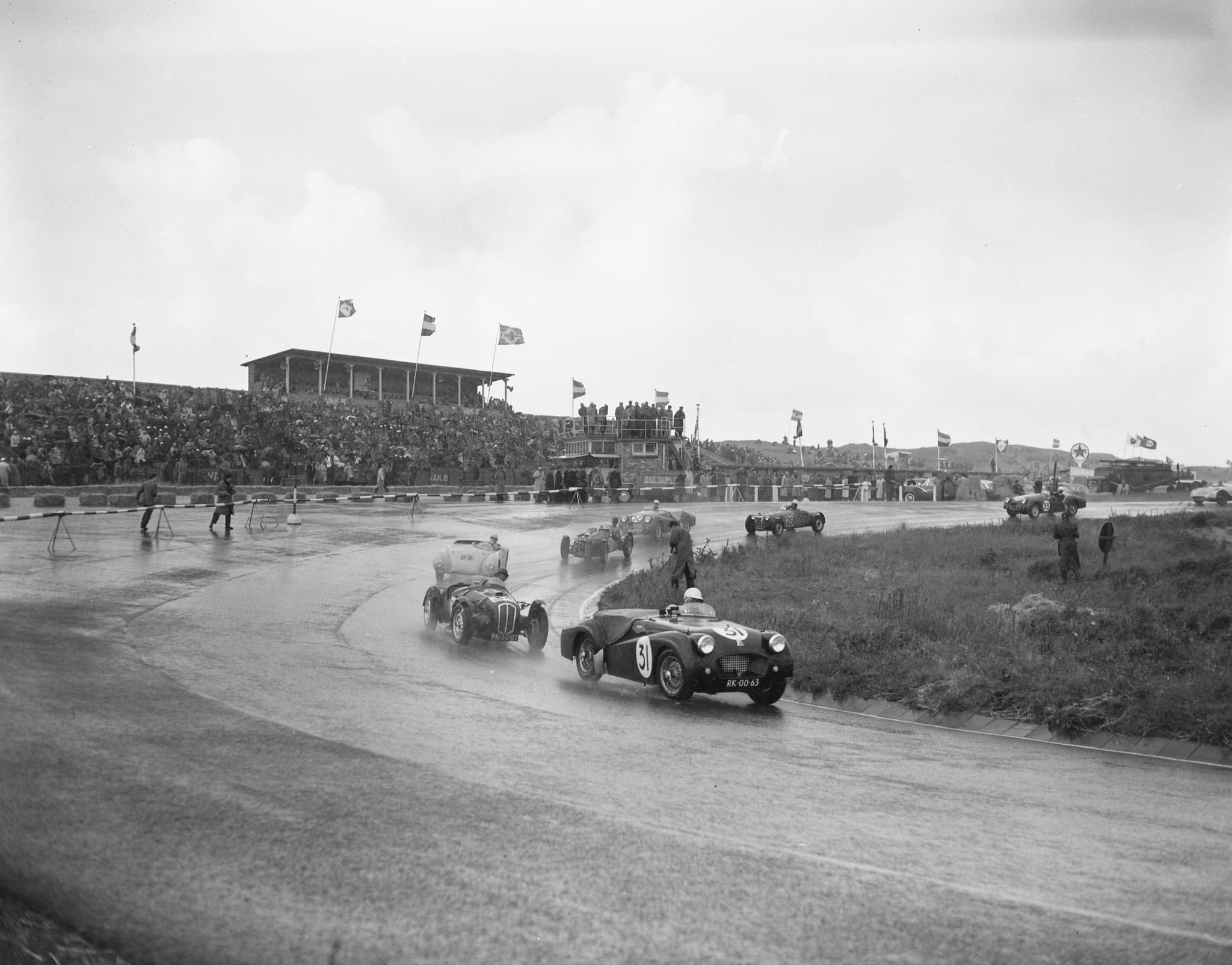
The TR2 was made quickly, and the sources do not agree on who did what. Sir John Black, Standard's chairman, asked for it; his stylist, Walter Belgrove, drew it, his engineers re-engineered it over one winter, and his test driver, Ken Richardson, proved it. The cards below give those whose part the sources record, drivers included; the sections give those known by no more than a line.source 1source 2source 3
Three accounts of who engineered the TR2 are in print, Bill Boddy's of July 1953, the TR Register's and Graham Robson's for the Rimmer catalogue, and they name different people; Belgrove's page sets them side by side.
Some of the people the sources name are known by no more than a line:
The chassis, in the TR Register's list of the engineers of the 20TS's redesign.
The engine, in the same list.
The transmission, in the same list.
The middle name of Boddy's engineering team of three; no source read gives a first name or a role.
In Belgium, the Coupé Francorchamps was the work of Impéria's own engineer, Frans Pardon, whose card is below. The decision to build it was taken by the company's managers in 1954, with Standard's agreement, Classic Motorsports says, but it names none of them, and no other source read does.source 6source 7
Every driver the results name has a card below, under the name the results print; Triumph TR2 racing lists their results. The American owners' club's newsletter also names a winner at Cheyenne in September 1955, "R. Kastner".source 8
Co-drove Steed's TR2 in the 1955 Mille Miglia; it did not finish.
chief stylist, stylist
Car stylist. According to the Standard Motor Club, he was born in Liverpool in 1900, was chief stylist of the pre-war Triumph company from 1934 and formed Standard's first styling department after the war. He drew the Standard Vanguard, the TRX and the 20TS, from which the TR2 was developed; in 1978 J. R. Davy credited him with the Renown, the Vanguard and the TR2. After a complete falling-out with the chief engineer, Ted Grinham, he resigned after the 1955 Motor Show, later took small commissions (among them bodywork for the Ferguson P99), retired to Devon and died in 1983.
chairman
Head of the Standard Motor Company, which bought the bankrupt Triumph company's name and remnants in 1944–45. He set out to give Standard a Triumph sports car for the American market, against MG and Jaguar: first the TRX of 1950, given up after three prototypes, then the 20TS of 1952, which became the TR2. He was hurt when a Swallow Doretti crashed with Ken Richardson demonstrating it, and he left the board; Motor Sport cleared the car of blame and named Alick Dick as Standard's new head.
Co-drove Ted Lund's TR2 to 19th in the 1954 Tourist Trophy.
British racing driver. In TR2s he was 94th in the 1954 Mille Miglia with Jack Fairman, 22nd in the 1954 Tourist Trophy, 59th in the 1955 Mille Miglia (the only one of five TR2s to finish), and 19th at Le Mans in 1955 in the works car PKV 374 with Mortimer Morris-Goodall, after digging it out of the sand at Tertre Rouge, by the car's 2019 sale catalogue's account.
Shared Edgar Wadsworth's TR2 at Le Mans in 1954, finishing 15th.
Winner of the first Macau Grand Prix, 31 October 1954, in one of three TR2s prepared by Far East Motors, the Hong Kong distributor; the race ran 51 laps, about 200 miles, and took him just over four hours (FIA).
2nd overall on the 1954 RAC Rally in a TR2, behind Johnny Wallwork's.
managing director
Managing director of the Standard Motor Company, later Standard-Triumph, from early 1954, when Motor Sport saw "young Alick Dick" set up "as head of the Standard empire" on Sir John Black's retirement, until Leyland's takeover in 1961. The TR3 and most TR3As were built under him. Michelotti's arrival is told two ways: Graham Robson says he was introduced through Raymond Flower and hired on Harry Webster's recommendation with Dick's approval; G. William Krause says the TR3 "Dream Car" followed a chance meeting between Dick and Michelotti at a motor show.
British racing driver. In TR2s: 20th in the 1954 Tourist Trophy and 22nd in the 1955 race, both with a co-driver printed only as Richardson, and 14th at Le Mans in 1955 in the works car PKV 376 with Ninian Sanderson.
British racing driver. He shared Leslie Brooke's TR2 in the 1954 Mille Miglia, 94th; racingsportscars' page for him lists that drive.
Drove in the Triumph TR2 team, with Kat and Richardson, that won the Team Award on the 1954 Alpine Rally; Motor Sport prints only the surname.
Rally and racing driver. In TR2s he finished the 1954 Mille Miglia with Ken Richardson (27th in racingsportscars' results; Motor Sport reported 28th at the time). In TR3s, one of five Coupes des Alpes on the 1956 Alpine Rally; with Marcel Becquart 6th overall and 1st in class on the 1958 Monte Carlo Rally; 2nd in class, 5th overall, on the 1958 Liège–Rome–Liège.
chief engineer
Chief engineer of the Standard Motor Company in the TR2 years. Bill Boddy credited the TR2 to an engineering team of three, Grinham, Dawtrey and Belgrove, in July 1953, and TR-Register Deutschland credits Grinham with the wet-liner engine. The Standard Motor Club says he and Walter Belgrove were often at odds, Grinham accusing Belgrove of designing cars he could not build. Harry Webster took over as director of engineering when Grinham retired in May 1957 (Webster's obituary in The Independent).
Racing driver; shared the works TR2 PKV 375 with Ken Richardson at Le Mans in 1955, finishing 15th.
Co-drove Scott-Russell's TR2 in the 1955 Mille Miglia; it did not finish.
Co-drove Alan Patterson's TR2 at Sebring in 1954, 24th.
Co-drove Margairaz's TR2 in the 1955 Mille Miglia; it did not finish.
With a co-driver printed only as Titterington he was 18th in the 1954 Tourist Trophy in a TR2 he entered; in 1955 he entered two TR2s in the race (racingsportscars, which also prints him as "Jasper B. Johnstone").
Drove in the Triumph TR2 team, with Gatsonides and Richardson as Motor Sport prints them, that won the Team Award on the 1954 Alpine Rally.
Co-drove Leslie Brooke's TR2 to 59th in the 1955 Mille Miglia, the only one of the five TR2s to finish.
British driver; 19th in the 1954 Tourist Trophy in a TR2 he entered, with Blackburn.
Drove a TR2 in the 1955 Mille Miglia, with Huguenin; it did not finish.
Co-drove Brian McCaldin's TR2 in the Tourist Trophy: 17th in 1954, retired in 1955.
British driver. With Maunsell he was 17th in the 1954 Tourist Trophy in a TR2, the best of the six that finished, and he retired in the 1955 race. With Desmond Titterington, 2nd in class and 8th overall on the 1958 Alpine Rally in a works TR3.
British driver; 24th in the 1954 Tourist Trophy in a TR2 he entered, with Tew.
Racing driver ("Mort"). He had left Austin-Healey for Solex by early 1955 (Motor Sport), and shared the works TR2 PKV 374 with Leslie Brooke at Le Mans that year, finishing 19th.
Drove a TR2 at Sebring in 1955 with Skogmo; it retired with a failed head gasket.
designer
Engineer at Impéria, Nessonvaux, Belgium, which assembled TR2s from kits, and designer of the TR2 Coupé Francorchamps of 1954–55; the Impéria badge on the coupé's wing carries his initials. According to Classic Motorsports he also drew the Vanguard cabriolet shown at Brussels in 1950.
American driver; with Hendricks, 24th overall and 3rd in the 2-litre sports class at Sebring in 1954 in the TR2 he entered.
One of the two drivers printed "Perrier / Perrier" in a TR2 in the 1955 Mille Miglia; it did not finish.
One of the two drivers printed "Perrier / Perrier" in a TR2 in the 1955 Mille Miglia; it did not finish.
Co-drove Bob Dickson's TR2 to 22nd in the 1955 Tourist Trophy; racingsportscars prints only the surname.
Co-drove Bob Dickson's TR2 to 20th in the 1954 Tourist Trophy; racingsportscars and Motor Sport print only the surname.
Drove in the Triumph TR2 team, with Gatsonides and Kat, that won the Team Award on the 1954 Alpine Rally; Motor Sport prints only the surname.
development and test driver, chief test driver, competition manager
British engineer, test driver and competition manager. According to oldracingcars.com he was born in Bourne, Lincolnshire, in 1911 and died there in 1997, and for many years was BRM's development and test driver. He joined Standard-Triumph in 1952 after driving the 20TS prototype, which he reputedly condemned as unsafe; he tested and developed the TR2, drove it at Jabbeke in May 1953, and from 1954 ran the new works competition department. Through the TR3 years he managed the works team: five Coupes des Alpes and the team prize on the 1956 Alpine Rally, where his own car retired after losing a rear wheel, and the three TR3S twin-cams at Le Mans in 1959. A Moss Motoring profile says he left for TVR in 1962, unhappy with the Leyland takeover.
Shared H. E. Rumsey's TR2, 2nd overall on the 1955 RAC Rally.
Racing driver: 3rd in the first Macau Grand Prix, 1954, in a TR2 (racingsportscars).
2nd overall on the 1955 RAC Rally in a TR2, with P. P. Roberts.
Racing driver. With Bob Dickson he finished 14th at Le Mans in 1955 in the works TR2 PKV 376, and he won the race outright the next year. He drove one of the three works TR3S twin-cams at Le Mans in 1959 and set the team's best practice lap, 4 min 49.8 s; the car retired.
Co-drove Leslie Brooke's TR2 to 22nd in the 1954 Tourist Trophy; racingsportscars prints only the double surname.
Drove a British TR2 in the 1955 Mille Miglia, with Haig; it did not finish.
Co-drove Mott's TR2 at Sebring in 1955; it retired with a failed head gasket.
Drove a British TR2 in the 1955 Mille Miglia, with Adams; it did not finish.
Drove a TR2 in the 1954 Mille Miglia, with White; it did not finish.
Co-drove Ray Merrick's TR2 to 24th in the 1954 Tourist Trophy.
Co-drove J. B. Johnstone's TR2 to 18th in the 1954 Tourist Trophy. racingsportscars prints only the surname; its page for Desmond Titterington has him in a Ferrari in that race, so this is not shown to be him.
Co-drove a TR2 with Todd to 21st in the 1955 Tourist Trophy. racingsportscars prints only the surname; Desmond Titterington drove a works Jaguar in that race (Motor Sport), so this is not shown to be him.
Co-drove a TR2 with Titterington to 21st in the 1955 Tourist Trophy.
British amateur racing driver. He entered his own TR2, TS1730, at Le Mans in 1954 and finished 15th with John Brown; the 2019 sale catalogue of PKV 374 tells the works team of 1955 as following on from it.
Won the Ladies' Award on the 1954 RAC Rally in a TR2, 21st in the general category; Motor Sport printed her as "Mrs. M. Walker", and Ken Richardson, as Richard Heseltine quotes him, names her Mary Walker.
Rally driver who won the 1954 RAC Rally outright in a TR2, the car's first competition appearance by Ken Richardson's account, as Richard Heseltine quotes it, and its class for sports cars of 1,601–2,600 cc; who sat beside him is disputed. Entered by the works on the 1956 Alpine Rally in a TR3, with C. Corbishley, and on the 1959 Monte Carlo Rally.
apprentice, chief chassis engineer, chief engineer, director of engineering, technical director, group technical director
Standard-Triumph's engineering chief: director of engineering from 1957 (Graham Robson says 1956) to 1968. The TR Register names him as chief chassis engineer of the team that engineered the TR2. The Spitfire was his idea of a "Herald sports car"; he brought Giovanni Michelotti into Standard-Triumph's work in 1957, Graham Robson credits his "persuasive powers" with Leyland's approval of the 1960 prototype after Standard's financial collapse, and took Triumph back to Le Mans with Spitfires, which won the 1.15-litre GT class in 1965. After British Leyland was formed he moved to Longbridge; CBE in 1974. He died at Kenilworth, aged 89.
Co-drove Stoddart's TR2 in the 1954 Mille Miglia; it did not finish.
Racing driver: 2nd in the first Macau Grand Prix, 1954, in a TR2.
Every source the site cites is on the sources page.