Triumph TR2 Buyers Guide
What to check on a TR2 before buying one: its numbers, the body and frame, the trunnions and steering, the wet-liner engine, the gearbox, overdrive and axle, the brakes and wheels, and the later parts many cars now carry.
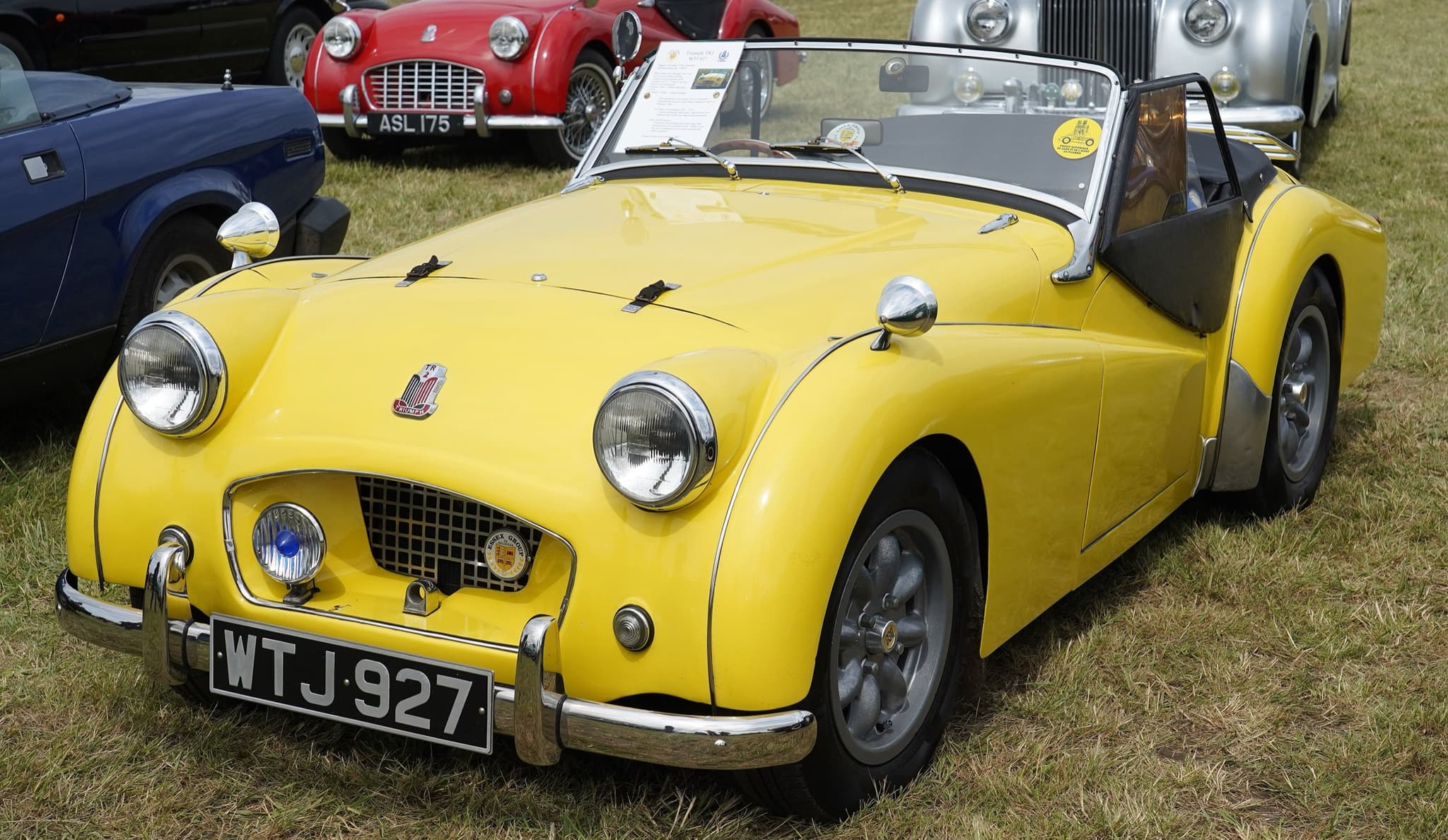
Assume that a TR2 for sale has been restored at least once, and spend the time on the body, not the engine. That is the advice of Bruno Dwinger's buying guide for TR-Register Deutschland, the fullest guide to the TR2 read, written in 2008 for every sidescreen TR, and the TR Register's general advice for all TRs agrees: they all rust, and many have been partly or wholly rebuilt. The figures on this page are Dwinger's unless another source is named.
It is fairly easy to see or feel the weaknesses of a TR.
Identity and originality first
Start with the numbers. The commission number is on a plate on the bulkhead under the bonnet (hood), and the engine number on the cylinder block; the TR Register advises checking that the commission number matches the one on the registration document, and then asking the club's registrar for the model about the car. A Heritage Certificate from the British Motor Museum gives the specification the car was built to. Triumph TR2 chassis numbers explains what the numbers and their letters mean.
The commission number also dates the parts. The early cars, to about TS550, had an aluminium bonnet, boot (trunk) lid and spare-wheel door; the short doors began at TS4002, the fixings for a hardtop at TS5260, the larger rear brakes after TS5481 and overdrive on three gears at TS6157. The change points by commission number list the rest. Revington TR, which compiled the list, adds a warning of its own:
Please bear in mind though that unless you have owned the car from new, and know different; the car is unlikely to be exactly as it left the factory.
Body
Dwinger and the TR Register agree on where a TR2's body rusts and where it is damaged.
The front panel
Seldom rusty, but often damaged and badly repaired.
The wings (fenders)
The seams of the front and rear wings, inside and out, and the tops of the wings, where rust starts from beneath.
Behind the front wheels
The cavity behind the closing panel, which collects dirt and water.
Sills and wing roots
Inner and outer sills (rocker panels) on the short-door cars, and the wing roots at the rear door post.
The door posts
With the doors open, the front and rear posts and the wing edges beside them.
The floors
The driver's floor under the carpet, and the joint with the bulkhead on the passenger's side.
The battery tray
Acid eats it, and it is often seen only with the battery out; a drain tube was added during 1954.
The doors
The lower third.
The tail
Below the rear lamps, the lower edge of the rear panel, and the joint of wing and body inside the boot.
Inside the panels
Inner panels should be the body colour; black or underseal is wrong. Glass-fibre panels can look original and are not.
Frame
The TR2's frame was built strong, the TR Register says, but it has to be checked for rust, for distortion from accidents and for poor repairs, with no unusual welds or patches.
As a rule the front half of the chassis is protected from corrosion by oil leaks, but it is most prone to impact damage. The rear half should be thoroughly checked for corrosion
Dwinger adds the outriggers that carry the body, the ends of the frame, the spring towers, the lower wishbone mountings and any creasing behind the front axle, and advises a lift. In 2008 he found no new frames available, and no source read says whether any are made today.source 2source 1
Front suspension and steering
The wishbone mountings should have no play. The stub axles turn in brass trunnions, which wear, Dwinger writes, because their lubrication is often forgotten or the wrong grease is used; the factory's chart specifies oil for them. The rubber gaiters of the upper ball joints split, and the joints then wear.
Die Schneckenlenkung war dem schnellen TR nie wirklich gewachsen.
In our translation: the worm steering was never really up to the fast TR. Dwinger means the factory's cam-and-lever box, which he also describes by its cam and lever. The relay lever wears, and rack-and-pinion conversions, which need the castor corrected, work but are not original. The factory's steering is described on the Triumph TR2 specs page.source 1source 3
Engine
The wet-liner four usually survives well, and its sound is easy to judge: irregular knocking or rattling is always serious, and the tappets may be heard but should not dominate. Dwinger's checks:
Leaks
No oil, water or fuel, except at the rear main bearing seal, unless a lip seal has been fitted.
Compression
Warm, every cylinder near 10 bar (145 psi); a leak-down test finds rings, valves or a head gasket.
Oil pressure
Warm, above 3 bar (40 psi) at 3,000 revolutions a minute. Boddy, reporting in February 1955, found what he called "a healthy 60 lb./sq. in." on his test car.
Temperature
Mid-gauge within 5 km (3 miles); the correct thermostat opens at 74 °C (165 °F).
Wear
The water pump and the carburettors' throttle spindles.
The engine's weak points were known from the start. Before production the test engine broke big-end bearings and exhaust valves at the Motor Industry Research Association's track, and the factory fitted tougher exhaust valves after engine TS481E, though the workshop manual gives no reason, and a cross-drilled crankshaft from TS881E. The works drivers, Richard Heseltine wrote in 2010, were told not to exceed 5,000 rpm. In 1954 a TR2 retired from the British Empire Trophy at Oulton Park with a failed big-end.
Engine numbers begin with TS and end with E, and the Heritage Certificate gives the one the car was built with.source 1source 7source 3source 5source 8source 9source 10
Gearbox, clutch, overdrive and axle
Every gear should engage without baulking. First has no synchromesh, which is normal: a TR, Dwinger writes, will take any corner in second. Grinding that stops when the clutch is pressed points to the gearbox (transmission) bearings, and a noise when it is pressed to the release bearing; to test for slip, try to move off in third with the handbrake on, and a sound clutch stalls the engine. The overdrive should engage and disengage promptly and cut the engine's speed by about a fifth. On the early cars it works in top gear only; from TS6157 it works in second, third and top.
At the back, the leaf springs' eye bushes and the links to the lever dampers wear, and tired springs show flattened or shifted leaves. There should be no more than 8 to 9 mm (about ⅓ in) of backlash at the differential flange, and the propeller shaft's universal joints should be checked by hand. The rear hub seals were revised at TS5114 and, Revington TR notes, still leaked; on the 1954 Alpine Rally one TR2 retired when a rear hub broke up.source 1source 11source 5source 12
Brakes and wheels
Every TR2 left the factory with drum brakes. Boddy found them powerful but fierce when pressed lightly, while Motor Trend found they needed "more pressure than usual". Later disc brakes, fitted to many cars since, are not original on a TR2.
Wire wheels were an extra. Their splines wear, which shows as a click when the car pulls away, and spokes break, so check the splines, the adapters and the hubs and every spoke. Dwinger advises truing and balancing them every two years, with no more than 1 to 1.5 mm of runout and no more than 30 g (1 oz) of balance weight on a bare rim. The steel disc wheels were made wider from TS1869, in May 1954, and stronger wheel nuts came from TS1927 that June; that summer Motor Sport reported two TR2s losing front wheels at club meetings.source 7source 13source 10source 1source 5source 14
Interior, weather equipment and instruments
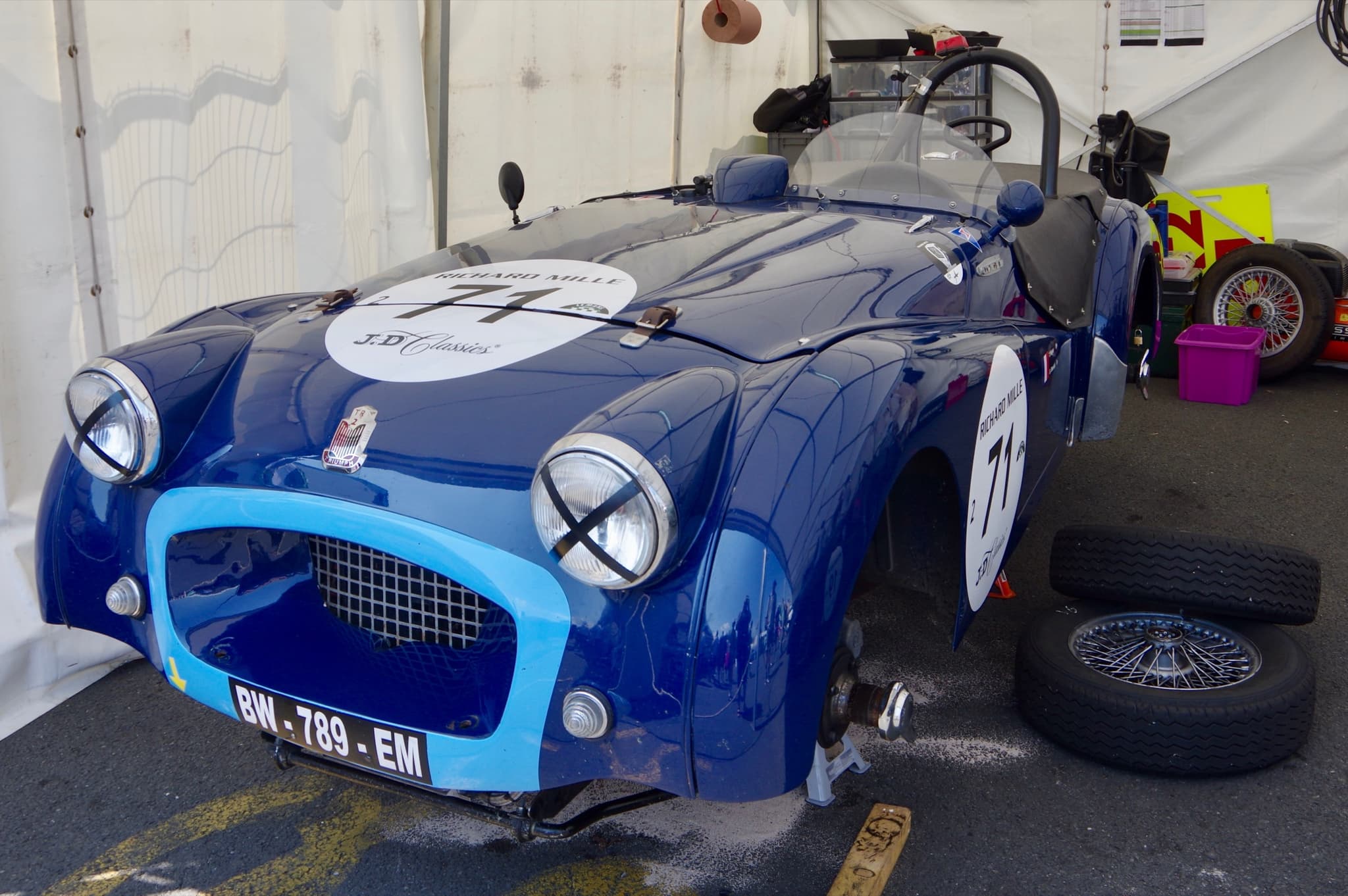
The interior should follow the original pattern, and reproduction carpets and trim are good; Vynide was the standard trim for the seats, and leather an extra. The instruments should be original, Dwinger writes, although some can no longer be found, and the fuel gauge with its hanging needle is scarce; reconditioning is possible but costly. He stresses the sidescreens' originality too.
The weather equipment was criticised from the first. American owners in 1955 named "the side curtains", the sidescreens, among their dislikes, and Boddy noted that the doors could be opened only from inside, through zip openings in the sidescreens. Sports Cars Illustrated found the car "obviously built to a price", the fit of its bonnet and boot lids leaving something to be desired. What the period testers made of the car is told on the Triumph TR2 review page.source 1source 11source 6source 7source 15
Modified and converted cars
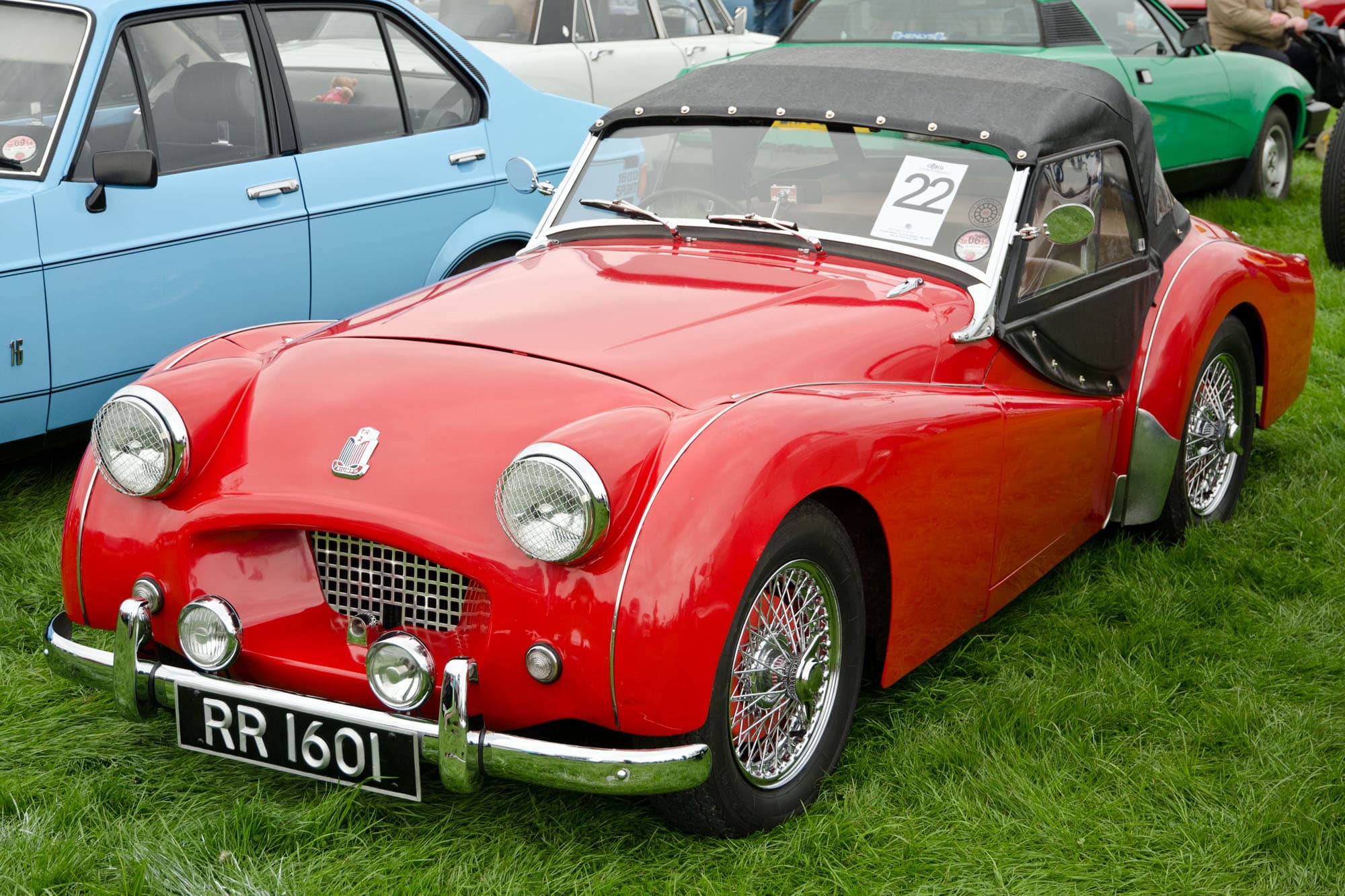
Many TR2s are not TR2s underneath.
It is not unusual to find a TR2 with a TR4 engine and gearbox, TR3A axle and TR6 disc brakes.
Dwinger warns of cars rebuilt with later parts up to the TR4's, of rack-and-pinion steering and of glass-fibre panels. Such cars may drive well; they are not original, and the Heritage Certificate shows what was. Many American cars have come back to Britain: all had left-hand drive, so check the original specification and the quality of any conversion, and the TR Register warns that "not all US cars spent their entire life in 'dry' States".
The Belgian cars, with an N after the commission number, and the Triumph TR2 Francorchamps coupés carry parts Impéria made itself, among them the coupé's locks, roof panel, ash inner frame and mechanical overdrive, which accounts of 2014 and 2016 found hard to come by. A racing history is not originality either. Triumph TR2 parts sets out what was still made and what the TR3 shares.source 10source 1source 2source 16source 17
Sources
Every source the site cites is on the sources page.
- Primarymade at the time, by the maker or by people who were there
- Referenceserious later work: clubs, specialists, magazines, books
- Bruno Dwinger, "TR 2 bis TR 3 B: Geschichte, Typen und Kaufberatung", TR-Register Deutschland, Nov 2008, 10 pp. (PDF), the guide, introduction; Karosserie; Rahmen; Fahrwerk, Lenkung; p. 7, Motor; pp. 7–8, Getriebe, Overdrive, Hinterachse; p. 9, Räder; Innenraum, Instrumente, Seitenscheiben; later parts; glass-fibre panels; rack conversions. tr-register.de/wp-content/uploads/2025/10/Kaufberatung_Geschichte_TR2_TR3.pdf Reference
- TR Register, "Buyer Beware: TR6" (2 pp. PDF leaflet), p. 1; p. 2, the commission number, the V5 and the registrars; pp. 2–3, the body; p. 2, the chassis; p. 2, US cars. tr-register.co.uk/storage/Pages/tr6-buyer-beware.pdf Reference
- Standard-Triumph, Triumph TR2 Workshop Manual, with the TR3 supplement, general data, "Car number (Commission number) ... Plate on dash"; battery box drain, TS3288; lubrication chart; steering; engine, exhaust valves after TS481E. Primary
- British Motor Museum (BMIHT), "Heritage Certificates". britishmotormuseum.co.uk/archive/heritage-certificates Primary
- Revington TR, "Technical Specification Change Points" (TR2), introduction; February 1954, about TS550; October 1954, TS4002; August 1954, TS3268; March 1954, TS881E; February 1955, TS5114; May 1955, TS6157; May and June 1954, TS1869 and TS1927. revingtontr.com/the-tr-series/tr2/technical-specification-change-points Reference
- Triumph Sports Owners Association, Triumph Sports Owners Association Newsletter, May 1955, May 1955 (vol. I), the owners' poll, what they liked least; the owners' poll. vintagetriumphregister.org/tsoa/TSOAMay1955.pdf Primary
- Bill Boddy ("W.B."), "Impressions of the Triumph TR2", Motor Sport, Feb 1955, p. 30, p. 30, oil pressure; p. 30, the brakes; p. 30, the doors. motorsportmagazine.com/archive/article/february-1955/30/impressions-of-the-triumph-tr2 Primary
- Richard Heseltine, "Triumph TR2/3", Motor Sport, Jan 2010, p. 122, p. 122, 5,000 rpm. motorsportmagazine.com/archive/article/january-2010/122/by-richard-heseltine Reference
- Motor Sport, "B.R.D.C. British Empire Trophy Sports-Car Race at Oulton", May 1954, p. 16, p. 16. motorsportmagazine.com/archive/article/may-1954/16/brdc-british-empire-trophy-sports-car-race-at-oulton Primary
- Revington TR, "TR2", later engines; later disc brakes; TR2 page, modified survivors. revingtontr.com/the-tr-series/tr2 Reference
- Triumph Motor Company (1945) Ltd, Triumph T.R.2 Sports Car (sales brochure), Rep. 12.53 (Dec 1953), Specification: synchromesh; "Body Specification"; "Optional Extras". Primary
- Motor Sport, "Matters Of Moment" (the 1954 Alpine Rally), Sep 1954, p. 15, p. 15, the Alpine Rally. motorsportmagazine.com/archive/article/september-1954/15/matters-of-moment-september-1954 Primary
- Walt Woron, "Driving around with Walt Woron: Triumph TR-2", with "The Story in Figures", Motor Trend, May 1954, pp. 39–41, 51, the brakes. Primary
- Motor Sport, "The M.M.E.C. At Silverstone (June 5th)", Jul 1954, p. 50, p. 50. motorsportmagazine.com/archive/article/july-1954/50/the-mmec-at-silverstone-june-5th Primary
- Al Brannon, "Trying the Triumph", Sports Cars Illustrated, Nov 1955, pp. 19–21, pp. 19–21, finish. Primary
- Dirk De Jager, "Through the Roof: The Hardtop Triumph TR2 That Held Promises of the Belgian Auto Industry", Classic Motorsports, Jul 2016, Impéria's own parts. classicmotorsports.com/articles/through-roof-hardtop-triumph-tr2-held-promises-bel Reference
- Bernard Stibling (interviewer), "Triumph du mois: TR2 Francorchamps", Triumph Club de France, Nov 2014, parts made for the restoration. triumph-club-de-france.fr/actualites/triumph-du-mois/1740-2014-11-triumph-tr2-francorchamps Reference